Stop Owing Debt. Start Owning It.
A bond puts you on the other side of the loan — the side that gets paid.
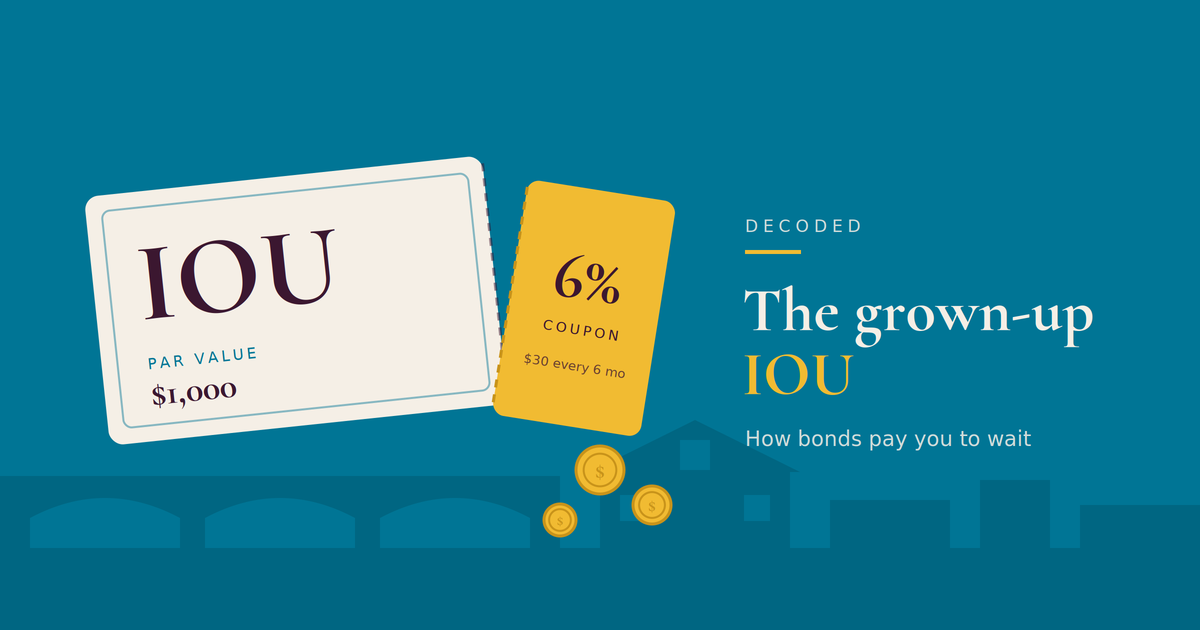
The grown-up IOU
You know when you Venmo a friend and they go "I got you next week"? Congrats — you basically get how a bond works. A bond is an IOU with a paycheck attached: you lend money, and you get paid to wait.
When a company or a government needs cash but doesn't want to give away ownership, they borrow from a crowd. Each slice of that loan is a bond, and you can own one. Lend to Uncle Sam, and it's a Treasury; lend to Apple, Google, or Meta, and it's a corporate bond. Same IOU, different borrower.
Same IOU, different reasons
When a company borrows, it's a choice. Corporations have two ways to raise money: sell a piece of ownership (that's stock — new owners, forever) or borrow (that's bonds — pay it back, nobody new at the table). Issuing bonds lets a company fund a new factory or a product launch without handing over a slice of the business.
When a government borrows, there's no ownership to sell. You can't buy a share of the United States, or of your city. So bonds — alongside taxes — are how governments raise real money for big things:
- The federal government issues Treasuries to fund national spending.
- A state or local government issues municipal bonds ("munis") for the stuff you can actually see: building a highway, renovating the schools in your district, fixing the water system.
So next time you drive a fresh overpass or your old high school gets a new gym, odds are a bond paid for it — investors earn interest while the community gets the upgrade.
Who you lend to changes the deal
Here's the thing about lending: the safer the borrower, the less they have to pay you to say yes.
- The U.S. government is the friend who has never once flaked. It can tax and print to pay you back, so it barely has to sweeten the deal — Treasuries pay modest interest, but they're about as steady as it gets.
- A megacorp like Apple, Google, or Meta is the friend with a great job and real savings. Very likely to pay you back — just not government-likely, so they toss in a little extra interest for your trouble.
- A shakier company is the buddy with "a business idea." The promised payout is juicy (that's high-yield, a.k.a. junk), but there's a real chance you get left on read.
More risk, more interest. That trade-off is the whole game.
The numbers that matter
- Par value — the sticker price, usually $1,000. That's how much you're lending.
- Coupon rate — your "thanks for the loan" interest. A 6% coupon on a $1,000 bond drops $60 a year in your lap ($30 every six months). Not yacht money, but it shows up like clockwork.
- Yield — the plot twist. The coupon is locked in, but the bond can be resold and its price floats. Yield is what you actually earn once you factor in the price paid.
Rates go up, shiny new bonds pay more, and your older lower-paying one looks a little less cute on the resale shelf. Rates drop? Suddenly it's the popular kid.
You're probably already a lender
Bet you've loaned the government money without even noticing. Open your 401(k) — specifically that target-date fund most jobs drop you into by default — and a slice of it is bonds, a big chunk of those U.S. Treasuries. Got a savings bond from a grandparent once? Same deal. Cash sitting in a money-market fund? Often Treasuries too. You've quietly been Uncle Sam's lender since your first paycheck.
Why the words blur together
Bonds, debt, and fixed income get tossed around like they're the same word — and for the big picture, treating them that way mostly works: you lend money, you collect interest. Nail that and you're 90% there.
But here's the fun wrinkle. Fixed income also includes preferred stock — and stock is ownership, not debt. So why does an ownership thing get filed under "fixed income"? Great question… and a story for another day.